Choose your file
Upload an audio or video file from your device. We check the actual media before converting.
YOUR AUDIO. YOUR WAY.
Extract the first audio track from MP4, MOV or WebM. Choose your MP3 quality, preview the result and download.
or choose an audio or video file from your device
One file · Up to 75 MiB · 30 minutes
Auto preserves mono and stereo. Surround audio is mixed down to stereo.
A higher bitrate cannot restore detail missing from the original.
Files are temporarily uploaded to our server. Results are available for 60 minutes. You can request deletion earlier. How we handle your files
Every result is checked and decoded before it becomes available.
Four bitrates. Mono or stereo. No promises of magically improving your original audio.
Results expire automatically. Request earlier deletion directly from your conversion.
One file at a time. The first audio track is used. MP3 is a lossy format; conversion does not improve the source.
See all supported formats →A few clicks. A compatible audio file. Nothing to install.
Upload an audio or video file from your device. We check the actual media before converting.
Use the balanced 192 kbps setting, or choose the bitrate and channels that fit your needs.
Preview your verified MP3, save it to your device, and delete the server copy whenever you are ready.
Extract audio from a video, or make an MP3 copy of your recording.
Practical answers, without the audio jargon.
THE COMPLETE GUIDE
Choose a video by its container and audio track, decide whether the picture is needed, then create a listening copy you can actually use.
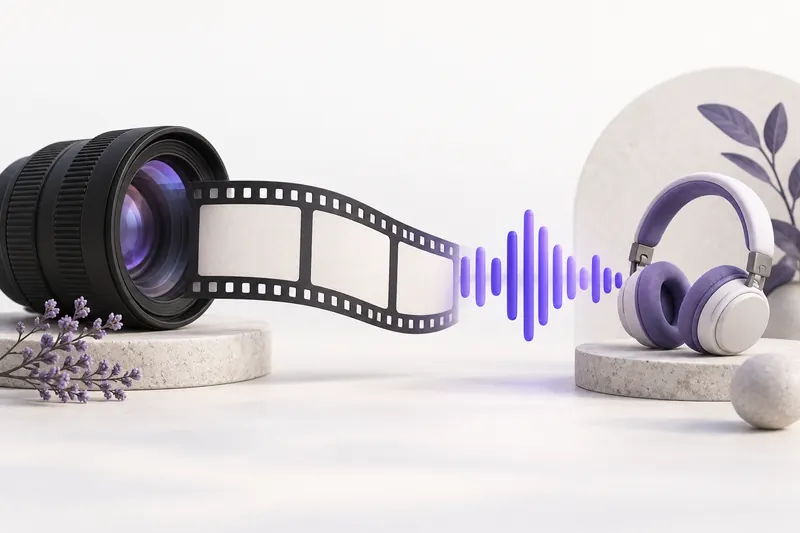
This video hub accepts the tested MP4, MOV and WebM families. MP4 can provide AAC LC or MP3; MOV can provide AAC LC or supported PCM; WebM can provide Opus or Vorbis. The audio representation determines whether the sound can be processed. A supported picture codec is not a substitute for a supported audio track.
Continue with a practical guide
Interviews, spoken lessons and rehearsals are promising audio tasks. Visual tutorials, demonstrations and slides may need the picture to remain understandable. Listen to one representative passage before converting the full file. Keep the video for the parts that rely on diagrams, subtitles or movements you cannot infer from speech alone.
The current converter uses the first audio track and does not offer track selection. If a file has several languages or microphones, prepare the desired first track in the source export. If no audio was recorded, there is nothing to extract. Raising the bitrate cannot create a missing voice, remove noise or replace the recording process.
Continue with a practical guide
The source is limited to 75 MiB and 30 minutes, measured before conversion. Video pictures can account for most of its bytes. A lower output bitrate changes the MP3, not the incoming video size. Use a local editor for a suitable shorter export when necessary; this tool does not trim video or import a web link.
| File or concept | Relationship | What it means |
|---|---|---|
| Video conversion | uses | the first audio track |
| MP3 output | omits | picture and subtitle streams |
Start at 192 kbps unless the destination gives you a different requirement. Compare 128 kbps when compactness matters, or 256/320 kbps when you can allocate more space. These are constant-bitrate MP3 settings. A higher number cannot recover detail already absent from the input, and your original remains the best reference for judging the copy.
Ten minutes at 192 kbps is approximately 14.4 MB of audio payload. Ten minutes at 320 kbps is about 24 MB. Mono versus stereo does not halve that estimate at the same total bitrate. Select channels for the recording, then check the actual duration, channel count and size shown with the finished result.
Continue with a practical guide
Listen to the beginning, a demanding middle passage and the ending. Check that the expected speaker or music is present and try the MP3 in its intended app. The converter verifies readable output, but your listening check establishes whether the file suits your task. Source tags and artwork are removed; organize the downloaded copy locally if you need them.
Your upload is processed temporarily on a server. The result is available for one hour; download it before relying on the temporary link. Delete files requests earlier cleanup and closes access. Wait for confirmed deletion, and retain your own source separately because a temporary conversion result is not a backup or an editing archive.
Continue with a practical guide
Use your own MP4, WAV, M4A, FLAC, OGG, AAC, WebM, MOV or WMA file. The supported formats reference lists the accepted codecs. This tool does not import a URL or download a video from another website.
No. A higher output bitrate cannot recover detail lost in the source. MP3 is always lossy. Keep WAV, FLAC or ALAC originals if you need an archival copy.
Files are temporarily processed on a server. The original is cleaned up after success and the MP3 expires after one hour. Delete files closes access and requests earlier cleanup; wait for the confirmed deletion status.